About
Program
In Brazil, graduate programs are accredited and evaluated annually by the Coordination for the Improvement of Higher Education Personnel (CAPES), which assigns a concept score from 3 to 7. The lowest value refers to a course with a satisfactory evaluation and authorization to operate only at the master's level, while score 7 refers to a program whose level is comparable to the best courses in the area abroad. Area committees (e.g., Interdisciplinary) periodically meet to elaborate the so-called Area Documents, which contain the main indicators for each field of knowledge to be used as a basis for the evaluation criteria of the programs.
The programs are evaluated every four years by CAPES, which maintains or assigns a new concept score to the program depending on its performance. In 2012, CAPES authorized the opening of PPGMC with a concept score of 3. The program evolved, reaching concept score 4 in the 2020 evaluation, which allowed the opening of the doctoral course in 2024.
CAPES Concept 4
Excellence recognized by national evaluationMaster's and Doctorate
Complete graduate programsQualified Faculty
Ph.D. professors and researchersCutting-Edge Research
Active laboratories and research groupsMission
To train human resources at the master's level to perform higher education teaching, scientific research, and technological development promotion activities, supported by the application of computational models and scientific simulation to solve problems in sciences and engineering.
The course involves the conception and development of mathematical and computational models, the development and application of numerical methods, the use of computational techniques and tools, and the validation of numerical and experimental solutions.
This general objective can be broken down into several specific objectives:
To provide solid training in the mathematical and computational principles of modeling for application in problems of sciences and engineering;
To enable the training and improvement of researchers in interdisciplinary areas with an emphasis on scientific computing applied to problems in sciences and engineering and their interfaces;
To favor training and improvement for the exercise of higher education teaching;
To awaken the spirit of initiative, entrepreneurship, and multidisciplinary and teamwork in the course graduates;
To enable graduates to conceive, design, elaborate, and process high-complexity scientific and technological models and systems;
To contribute to the strengthening of UESC and its consolidation as a regional leader in computational modeling and high-performance computing activities.
Research Lines
The course encompasses three research lines within the concentration area of Computational Modeling, each focusing on complementary scientific approaches that strengthen regional and technological development.

Computational Intelligence and Applications
Develops techniques that simulate intelligent behaviors, involving machine learning, computer vision, natural language processing, robotics, and autonomous systems. Its applications span health, finance, transportation, cybersecurity, and much more, focusing on solutions capable of interacting naturally with humans.

Mathematical and Computational Modeling
Covers the development and application of mathematical models, numerical techniques, and algorithms for the analysis of physical, biological, economic, and environmental phenomena. It includes optimization, solving complex systems, inverse problems, and advanced computational simulation.

Computational Techniques and Simulation
Focused on the creation of high-performance algorithms, codes, and simulation methods. It covers fluid dynamics, heat and mass transfer, reactive processes, particles, radioactivity, multiscale systems, and deterministic and stochastic models.
History


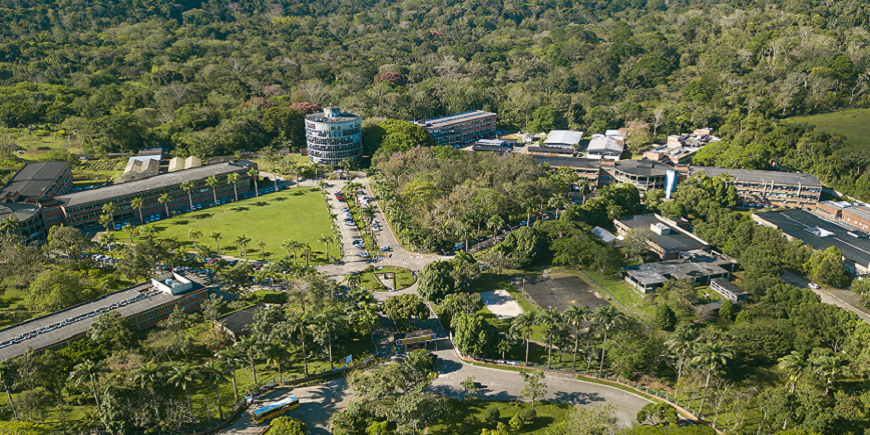
The State University of Santa Cruz (UESC) is an autarchy of the State Government of Bahia, being the only consolidated public institution for research, higher education, and extension located entirely in the South Coast Mesoregion of Bahia, with a population of approximately 2 million inhabitants. The UESC university campus is located between the two main urban centers of Southern Bahia, at km 16 of the Jorge Amado Highway, BR 415, in the municipality of Ilhéus. Its geo-educational area covers a vast territory, aggregating sub-regions known as Baixo Sul (11 municipalities), Sul (42 municipalities), and Extremo Sul (21 municipalities) of Bahia. In total, there are 74 municipalities, covering an area of 55,838 km2, corresponding to 9% of the State's area and about 16% of its population. With just over 20 years of history as a University, UESC has experienced the incorporation of a significant number of professionals who develop research activities in solving complex problems into its faculty of researchers, resulting in 33 stricto sensu courses, distributed among 26 graduate programs, serving all CAPES colleges. Of these, 8 are doctorates, 18 are academic master's programs, and 7 are professional master's programs. UESC's strong growth in recent years has consolidated its position as a prominent public IES at the state, regional, and national levels.
Since the early 2000s, researchers linked to the Department of Exact and Technological Sciences of UESC (DCET), which involves the areas of Computer Science, Mathematics, Engineering, Chemistry, and Physics, have been developing research in Mathematical and Computational Modeling and related interface areas. A relevant milestone was the creation in 2004 of the Laboratory of Applied and Computational Mathematics (LAMAC) through a research project financed by the Foundation for Research Support of the State of Bahia (FAPESB). Since then, the team members have worked diligently to consolidate and expand the laboratory's activities.
Over the past few years, the areas of Computing, Mathematics, and Engineering have made continuous efforts to attract professionals working in simulation and computational modeling to strengthen the performance of LAMAC. Another highlight in the strengthening of this research line was the creation, in March 2005, of the Research Group in Applied and Computational Mathematics (GPMAC) registered with CNPq. This group brings together researchers and students from various backgrounds under the common denominator of using scientific computing tools to solve problems in various areas of knowledge. The continuous effort of the group's researchers and the approval of several research projects by funding agencies allowed for the creation of a new headquarters at the facilities of the Computational Biology and Biotechnological Information Management Center (NBCGIB) of UESC. The move and installation of the laboratory in the new headquarters took place in July 2008, promoting the consolidation of LAMAC, supported by a modern, functional, and spacious physical space, in addition to having numerous state-of-the-art computational resources. Another important milestone in strengthening computational modeling research was the acquisition in 2012 of the CACAU supercomputer (Advanced Computing and Data Storage Center of UESC). A parallel machine with 20 calculation nodes, 160 cores, and 320 GB of RAM, at the time of acquisition it was classified as the most powerful cluster in the state of Bahia, and the second largest in the Northeast. This particular computer was financed with FINEP resources through its research infrastructure program. Over the years, several updates were made to the equipment and its support infrastructure. In 2018, a new major update of CACAU was approved in a competitive FINEP Public Notice, with the new equipment currently in the contracting phase.
The Master's in Computational Modeling in Science and Technology can be considered the result of the consolidation of LAMAC's work and is part of a planning and training program of DCET started in 2006, which has already resulted in the approval of a series of projects in national calls, innovative partnerships with the private sector (particularly with companies in the IT area), and the creation of stricto sensu graduate programs and various lato sensu courses. In 2010, the faculty researchers of GPMAC understood that it was the appropriate time to offer students in the region the opportunity to have a stricto sensu graduate course in the area of technology, and thus advance their training, solving local and universal problems at our university.
The current permanent faculty of the program consists of researchers with multidisciplinary backgrounds and, although all belong to the Department of Exact and Technological Sciences (DCET), they have primary activity in different areas of knowledge, such as Computational Modeling, Physics, Bioinformatics, Mathematics, Biomedical Informatics, and Engineering.
Since the beginning of the program's activities in 2013, annual selection processes have been held with approximately 17 students entering each year. The demand for the course in all selection processes has been significant, with at least three competitors for each offered spot. As of now (May 2021), the program has graduated 75 masters, and has 38 enrolled students. Currently, the PPGMC faculty members are working diligently to improve the course indicators with a view to submitting a proposal for a doctoral course given the region's needs.
Grants
Acceptance by the advisor or approval in the Selection Exam does not imply the automatic concession of a study grant. However, the course always seeks to obtain grants from funding agencies. In fact, before every selection process, the advising professors, in collaboration with the program coordination and the Pro-Rectory for Research and Graduate Studies (PROPP) of UESC, always request Social Demand grants from CAPES, FAPESB, and CNPq funding agencies.
Regular students without an employment relationship may apply for grants, taking into account the criteria established by the financing agencies and the Course Collegiate.
Grants are distributed according to the order of classification in the selection process and the requirements of the selection notice.
The duration of the master's grant is a maximum of 24 months.